
When Stress Shows Up in the Body: Learning to Listen to Your Symptoms
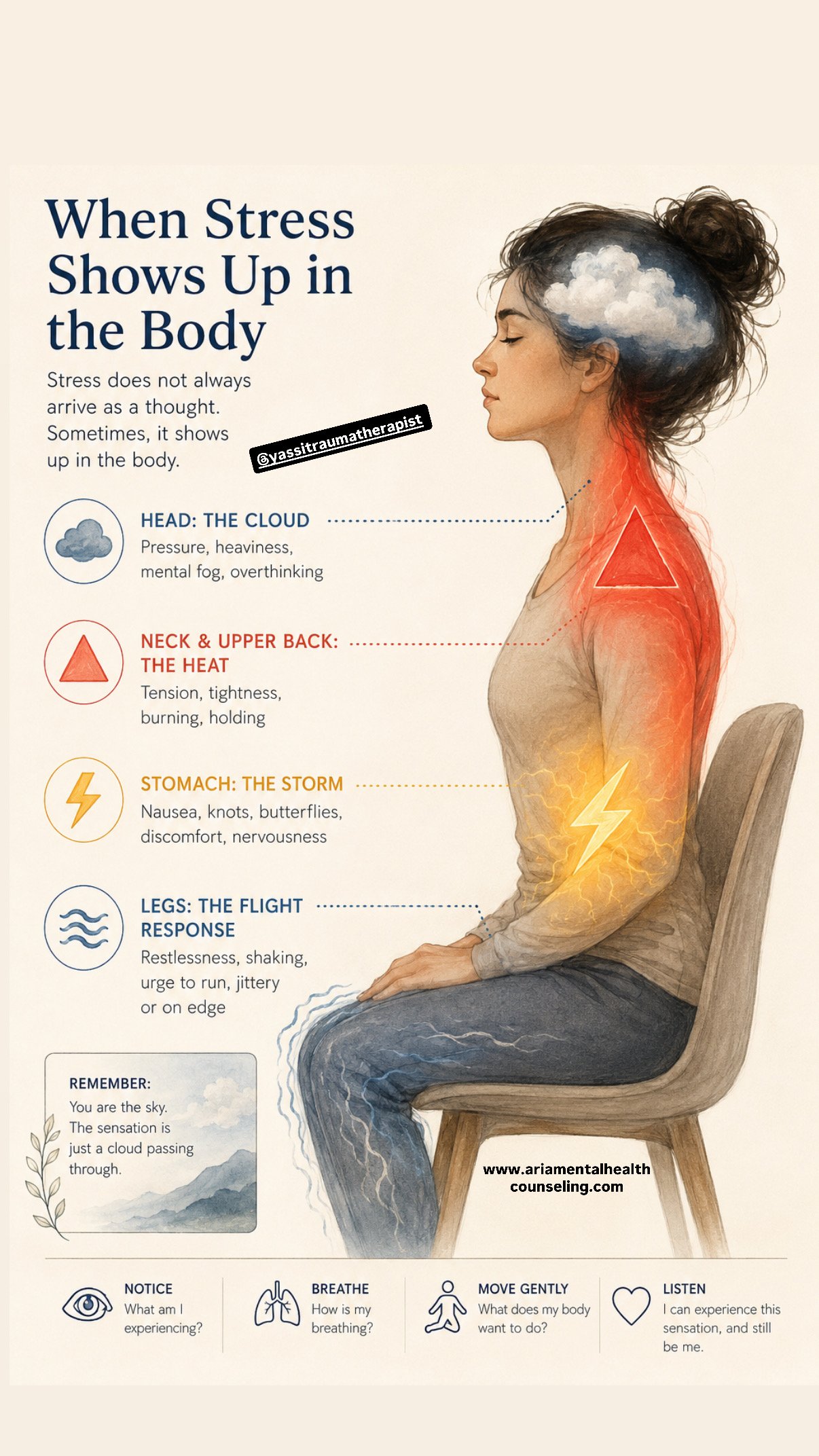
Stress does not always arrive as a thought. Sometimes, it shows up in the body.
You may notice a headache that seems to come out of nowhere, tingling or heaviness in your arm, tightness in your chest, a knot in your stomach, or a sensation that moves through your body when you feel overwhelmed. These sensations are real. And while they may have many possible causes, stress and emotional activation can sometimes intensify the way we experience them.
One way to begin working with these sensations is to slow down and become curious about them rather than immediately trying to make them disappear.
Start by noticing the shape
When you notice a sensation, pause.
Instead of immediately saying, “How do I get rid of this?” try asking:
“What does this sensation look like if I imagine it as an object?”
Does it have a shape?
Is it:
A cloud?
A triangle?
A rectangle?
A ball?
A line?
A wave?
Something completely different?
You don't have to get it “right.” You are simply giving your attention to the experience in a new way.
Notice its color
Now imagine that the sensation has a color.
What color would it be?
Red? Blue? Gray? Yellow? Black? Maybe it has several colors, or perhaps it changes as you observe it.
Again, there is no right answer. The goal isn't to analyze the sensation. It is to notice it.
Notice its temperature and movement
Then become curious about its physical qualities.
Is it:
Warm or cold?
Heavy or light?
Tight or loose?
Sharp or dull?
Tingling or numb?
Pulsing?
Moving?
Spreading?
Rising and falling?
Staying in one place?
Perhaps the tingling in your arm moves toward your hand and then retreats. Maybe the stomach pain tightens and releases. Maybe the headache feels like pressure at the back of your head that shifts when you change position.
Try simply observing.
“There is pressure here.”
“There is tingling here.”
“This sensation is moving.”
Rather than “My arm is tingling and something is wrong with me,” you are practicing noticing:
“I am experiencing tingling in my arm right now.”
That small shift can create space between you and the sensation.
You are the sky, not the cloud
One of the metaphors I often use is the sky and the clouds.
A sensation can feel enormous when we are caught inside it. Anxiety can make a headache feel frightening. Tingling can immediately trigger thoughts about what it might mean. Stomach pain can become the center of our attention.
But try imagining the sensation as a cloud passing through the sky.
The cloud is real. You don't have to deny it. But it is not the entire sky.
In the same way, a bodily sensation is something you are experiencing. It is not the whole of you.
You can notice the sensation while also noticing the chair beneath you, your feet on the floor, the room around you, the sounds you hear, and the space around your body.
This is one way of beginning to untangle yourself from the sensation and the emotion surrounding it.
Then notice your breathing
Without forcing yourself to take a deep breath, notice:
How am I breathing right now?
Is your breath shallow? Fast? Held? Mostly in your chest? Moving into your belly?
See if you can gradually allow your breath to become a little slower and fuller—without forcing it.
Then become curious:
Does the sensation change when my breathing changes?
Perhaps the headache softens slightly.
Perhaps the tingling becomes more noticeable before it decreases.
Perhaps the sensation moves somewhere else.
Maybe nothing changes at all.
That's okay.
You aren't trying to make your body perform a particular way. You are learning to stay present with your body without immediately becoming frightened by every sensation.
Ask the sensation what it wants to do
This can be a surprisingly powerful question:
“If this sensation could move, what would it want to do?”
Sometimes the body seems to want movement.
A headache may feel as though it wants to move out of the back of your head. Your shoulders may want to drop. Your hips may want to move. Your hands may want to shake.
If it feels comfortable and physically safe, allow yourself to experiment with very small, gentle movements.
You might slowly turn your neck a few degrees to the right and then back to center.
You might gently roll your shoulders.
You might allow your hips to sway.
You might gently shake out your hands or legs.
Think micro-movement, not exercise.
There is no need to force, stretch, or push through pain. You are simply giving your body permission to make a small movement and then noticing what happens.
“What changes when I move this way?”
“What changes when I stop?”
“Does my body want more movement, less movement, or stillness?”
You are listening rather than commanding.
From fighting the body to listening to it
The goal of this practice is not to convince yourself that every physical symptom is caused by stress. New, severe, persistent, or unexplained physical symptoms deserve appropriate medical evaluation. And symptoms such as sudden severe headache, new weakness or numbness, chest pain, difficulty breathing, or other concerning changes should be evaluated promptly.
But when you have already been medically evaluated and notice that certain sensations tend to arise or intensify during stress, learning to observe your body with curiosity can be an important part of developing a different relationship with those sensations.
Instead of:
“How do I make this stop?”
you can begin with:
“What am I noticing?”
“Where is it?”
“What is it doing?”
“How am I breathing?”
“What happens when I gently move?”
And perhaps most importantly:
“Can I experience this sensation without becoming the sensation?”
The sensation may be a cloud.
You are still the sky.